
Roblox data· Jul 20, 2026· 2 min read
How to find a Roblox game's player count history
Roblox shows you the number in a game right now and nothing before it. Here is what the platform actually exposes, and how to see a trend instead of an instant.
By Bloxism
Updated Jul 20, 2026
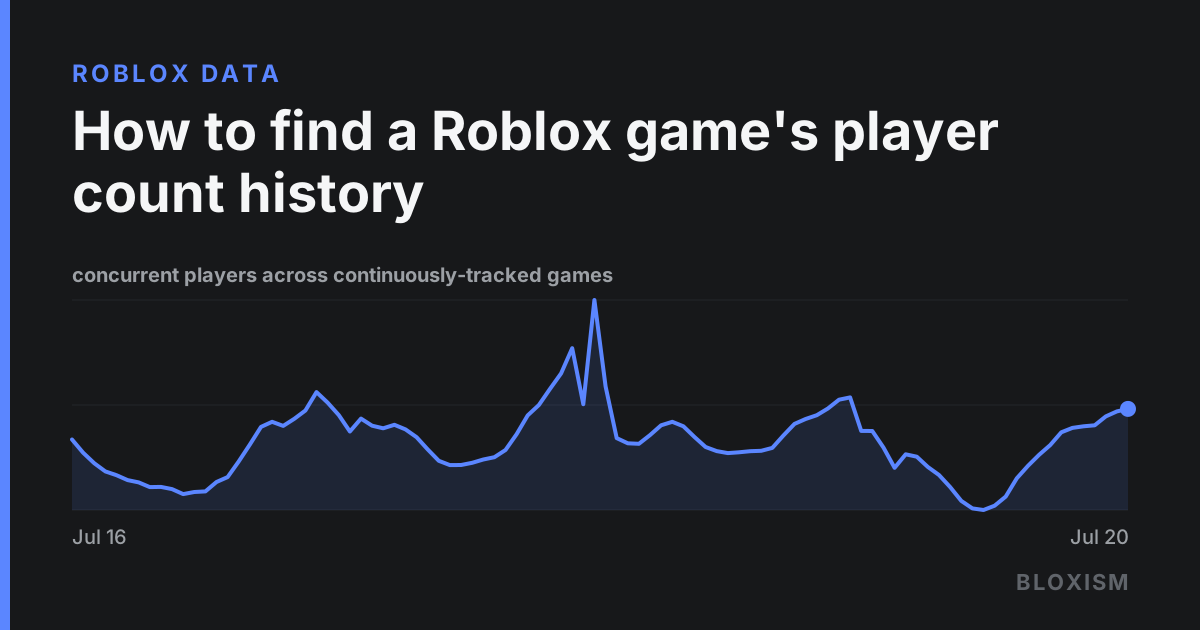
Roblox tells you how many people are in a game right now. It does not tell you what that number was yesterday, and it never has. If you want to know whether a game is growing, dying, or just having a quiet Tuesday afternoon, the platform alone cannot answer you.
What Roblox gives you
On any experience page you get:
- Active players — the count inside the game at this instant
- Visits — a lifetime cumulative total, which only ever goes up
- Favourites — another lifetime cumulative total
- Likes and dislikes — expressed as a rating percentage
Only the first of those is a current measurement. The rest are totals accumulated since the game launched, which is why a nine-year-old game with modest activity can show enormous visit numbers.
What Roblox does not give you
There is no public endpoint for a game's historical player count. If nobody was recording a game a month ago, that month is simply gone — it cannot be recovered later.
That single fact explains why player-count history sites exist at all: history has to be captured as it happens.
How to read a trend once you have one
Once you have a series rather than a point, three things become answerable:
Is this growing? Compare like with like — the same hour on different days. Roblox concurrency swings hugely between a weekday morning and a Saturday evening, so a raw "yesterday vs today" comparison mostly measures the clock.
Did that update do anything? Look at the days either side of it, and at whether any lift survived a week. A spike on release day is normal; a spike still standing seven days later is a real change.
Is this game in trouble? A single quiet day is noise. A downward slope across several weeks, at matched times of day, is a signal.
A caution about percentages
A game going from 3 players to 300 is a 9,900% rise and means nothing. Percentage change is only meaningful when the starting number was large enough to be real, which is why we refuse to call a game a "mover" unless both ends of the comparison clear a minimum and there is enough history behind it. Any growth-percentage list that does not do something similar will be topped by noise.
Seeing it
We record concurrency for every tracked game on a schedule and keep the history, so each game has a chart rather than a single number.